Explore The History of Somapura Mahavihara Buddhist Monastery
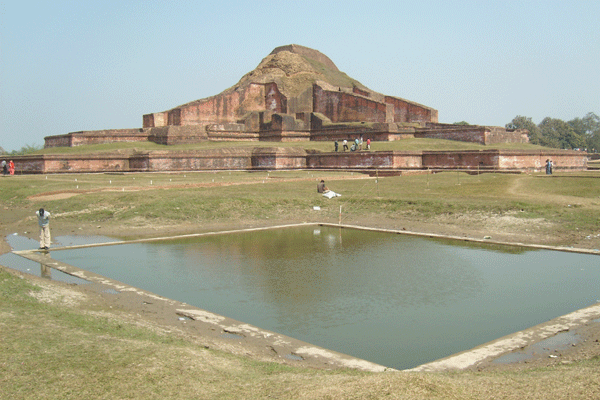
Somapura Mahavihara (Bangla: সোমপুর মহাবিহার) — also known as Paharpur Bihar (Bangla: পাহাড়পুর বিহার) or Paharpur Vihara — is located in Paharpur village, 34 km from Naogaon district town and about 16 km north of Badalgachhi upazila headquarters. It is near Jamalganj Railway Station, approximately 5 km to the west. Many refer to it as Paharpur (Pahar-পাহাড় meaning hill and Pur-পুর meaning city, village or locality) because its central temple is shaped like a hill. This Vihara brings international recognition to both Naogaon district and Bangladesh. It is the largest Buddhist monastery south of the Himalayas.
Somapura Mahavihara, in Paharpur, Naogaon – January 2023.
Discovery and Excavation History
The earliest reference to the remains of the Somapura Mahavihara is in Scottish explorer Francis Buchanan Hamilton’s journal. He surveyed East India from 1807 to 1812 AD. During that visit he came to Paharpur and was particularly attracted by this huge ruin of the Vihara. He saw a steep hill covered with deep forest and topped with a huge banyan tree. He assumed it to be a Buddhist Vihara. British army engineer Sir Alexander Cunningham came to Paharpur in 1879 AD and recorded the details. Later, he brought some laborers for extensive excavation at the site. At that time it was full of jungles and inhabited by venomous snakes and ferocious leopards. Mr. Cunningham cleared a portion of the forest and began digging. But the zamindar of Bolihar, the landlord of that area, opposed this work. As a result, Mr. Cunningham canceled the excavation.
After a long time, in 1923, the excavation work started again with the joint efforts of Calcutta University, Varendra Research Council and Archaeological Survey of India. This time, Sarat Kumar Roy of Dighapatia zamindar family helped financially in the excavation work.
Somapura Mahavihara before excavation.
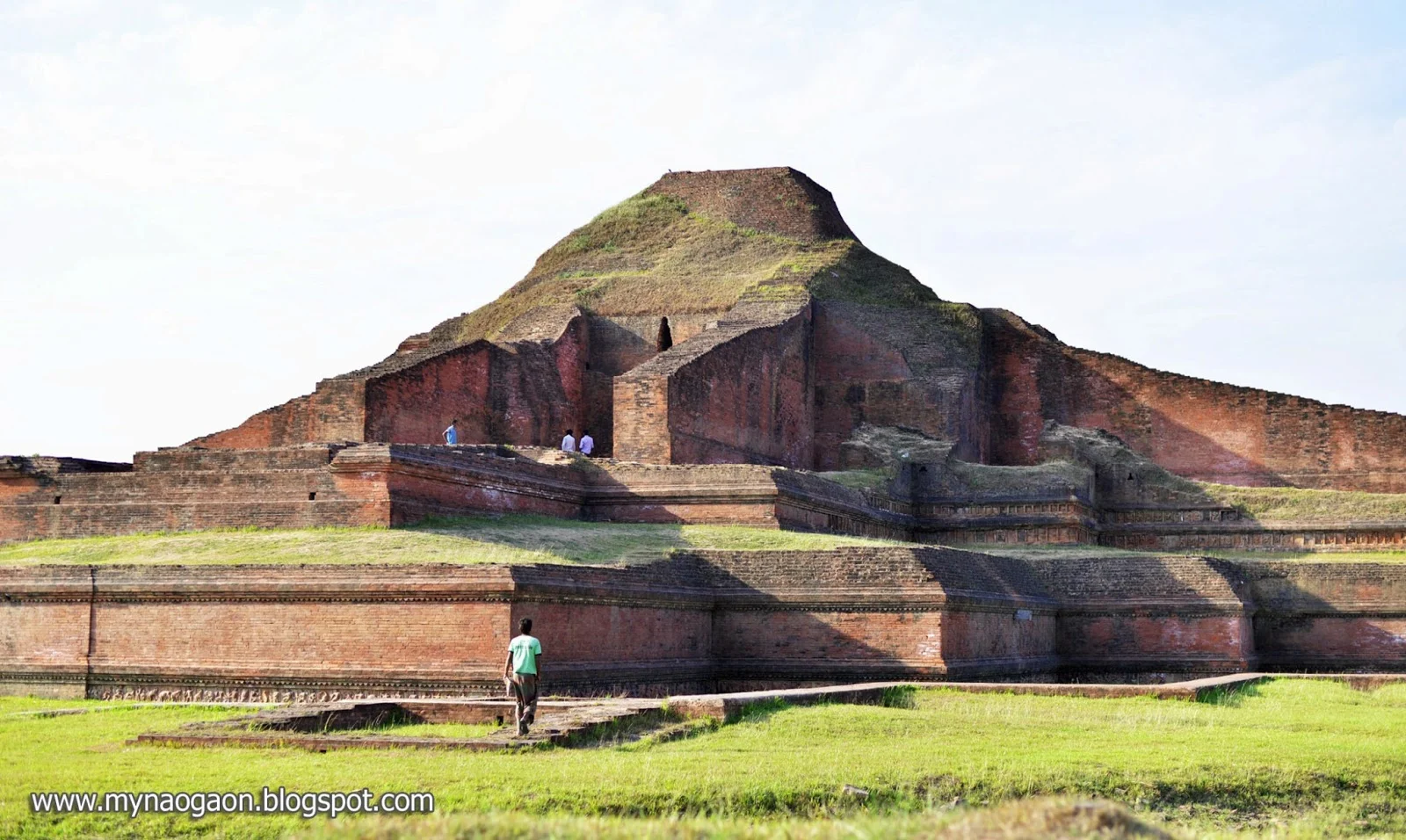
Somapura Buddhist Mahavihara in Paharpur village of Naogaon – 2023.
About Pala Empire
The Pala Empire (Bangla: পাল সাম্রাজ্য) was a Buddhist dynasty that ruled over parts of eastern India and present-day Bangladesh from the 8th to the 12th centuries. The Pala dynasty was founded by Gopala, who came to power in 750 AD. The Empire was known for its support of Buddhism and for the construction of many Buddhist monasteries and temples. During the Pala Empire, the capital of the dynasty was located in Pataliputra (now Patna). The Pala dynasty also controlled a large portion of modern-day Bangladesh, including the region around the Somapura Mahavihara.
Construction and features of Somapura Vihara
King Dharmapala II of the Pala dynasty built the Somapura Mahavihara in the 8th century (c. 781-821 AD). He chose today’s Paharpur village for the purpose of establishing a large Buddhist temple in the Varendra region. The existence of Somapura Mahavihara is mentioned in the Tibetan history book “Pag-SAM-Jon-Zhang” and in the writings of Lama Taranath. Tibetan sources sometimes attribute construction to King Devapala after the conquest of Varendra around 810-850. A clay seal found during excavation suggests that it is the Somapura Mahavihara.
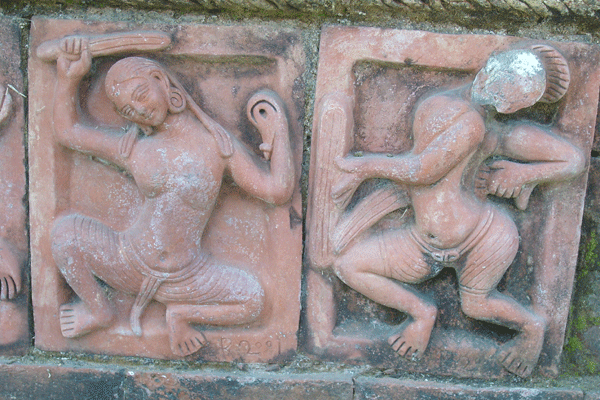
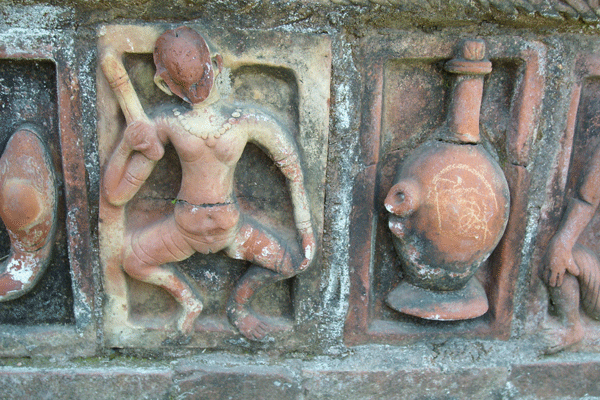
Terracotta on Somapura Vihara’s Central Temple Wall
Ground-corner view of the Central Temple with terracotta at Somapura Mahavihara, Naogaon, 2023.
Somapura Vihara is situated on a total land of 81 bighas (approx. 27 acres). The Vihara covers an area of approximately 281.20 meters (north-south) by 280.29 meters (east-west). It contains 177 habitable rooms for Buddhist monks. The complex includes a wide entrance, small temples, numerous votive stupas and ponds. At its center is the architecturally distinctive towering central temple. Currently, the central temple measures about 108.70 meters (356 ft 6 in) north-south and 95.80 meters (314 ft 3 in) east-west. The temple’s height now stands at 21.35 meters (70 ft).
Ancient Coins and Architecture of Somapura Mahavihara
A silver coin from the reign of Caliph Harun-ur-Rashid was found in an earthen pot in Room No. 125 during the excavation. These coins were struck from the Mohammadia mint in 788 AD during Harun-ur-Rashid’s reign. Scholars like Dr. Abdul Karim and Prof. Enamul Haque suggested that perhaps a saint or missionary brought these coins here. The craftsmanship of the architects from that era is evident in the Vihara’s construction. The central temple is pyramidal in shape, and the entire complex is encircled by strong boundaries with an entrance on the north side.
Currently, three rows of terracotta plaques can be seen on the temple walls (about 2,000 plaques). Around 800 more terracotta pieces were found during excavation. On the north side of the ruins lies a brick well (2.50 meters in diameter). To the west of this well is a long hall believed to be the dining hall; adjacent to it was the kitchen. Near the kitchen, three paved wells were discovered during excavation.
Designated by UNESCO
UNESCO designated the Somapura Mahavihara as a World Heritage Site in 1985. For the first time, in 1985 UNESCO declared “Somapura Mahavihara” along with “Historic Mosque City of Bagerhat” as World Heritage Sites from Bangladesh. Later in 1997, UNESCO recognized another Bangladeshi site, The Sundarbans. Somapura Mahavihara is an important example of Buddhist architecture in South Asia and an excellent representation of the region’s cultural and religious traditions.
Ruins of monk's cell at Somapura Buddhist Vihara -2023.
Corner view of Somapura Mahavihara temple ruins at Paharpur - 2023
Education Center
Somapura Mahavihara was first established as a residence for Buddhist monks, but later the Vihara became an important center of learning — functioning like a university for theology and other disciplines. Students from various countries gathered here. Notable residents included Maha Panditacharya Bodhi Bhadra and Acharya Atish Dipankar. Ratnakar Shanti served as the Mahasthabir of Sompur Vihar; ancient charagitika Kahnpa and his mentor Jalandhari Pa (also known as Hari Pa) were also associated with this Vihara.
Museum in Somapura Mahavihara
Artifacts found during excavations are preserved in a museum near the Vihara, built in 1950. Some artifacts are also kept in the Varendra Research Museum in Rajshahi. Items preserved include:
Chamunda idol in sandstone
Standing red stone idol of Shitala
Fragment of Vishnu in Krishna stone
Ganesha standing in black stone
Sandstone statue of Kirti
Oil painting of Maharani of Dubalhati
Damaged statue of Hargouri
Broken statue of Lakshmi Narayana in Krishna stone
Black stone Uma idol
Sandstone Gauri statue
Sandstone Vishnu idol
Nandi statue
Vishnu idol in black stone
Sun statue
Shiva Linga made of black stone
Sandstone statue of Mansa
Paharpur Archaeological Museum in Somapura Mahavihara site – 2023.
Visited by Famous People
Somapura Vihara has been visited by many notable figures and tourists from around the world, including leaders from the International Buddhist Association, Kurt Waldheim (former UN Secretary-General), the Queen of Spain, the Prince of Thailand, Sri Lankan President Premadasa, and ambassadors from countries like Australia, France, Nepal, and Bhutan.
Maintenance of The Historical Site
The site is maintained by the Directorate of Archaeology, Government of Bangladesh. A guest house is available for visitors by prior booking. The entrance features a well-decorated garden. Several toilets and large parking areas have been constructed, and wooden stairs help visitors move around while protecting the ruins. A group of Bangladesh Tourist Police has been deployed for security and assistance.
Somapura Mahavihara in 2023.
Bangladesh Tourist Police at Somapura Vihara site – 2023.
The Tourist Police Shed at Sompur Bihar, captured in 2023 AD.
Central temple of Paharpur or Somapura Vihara, Naogaon - 2008
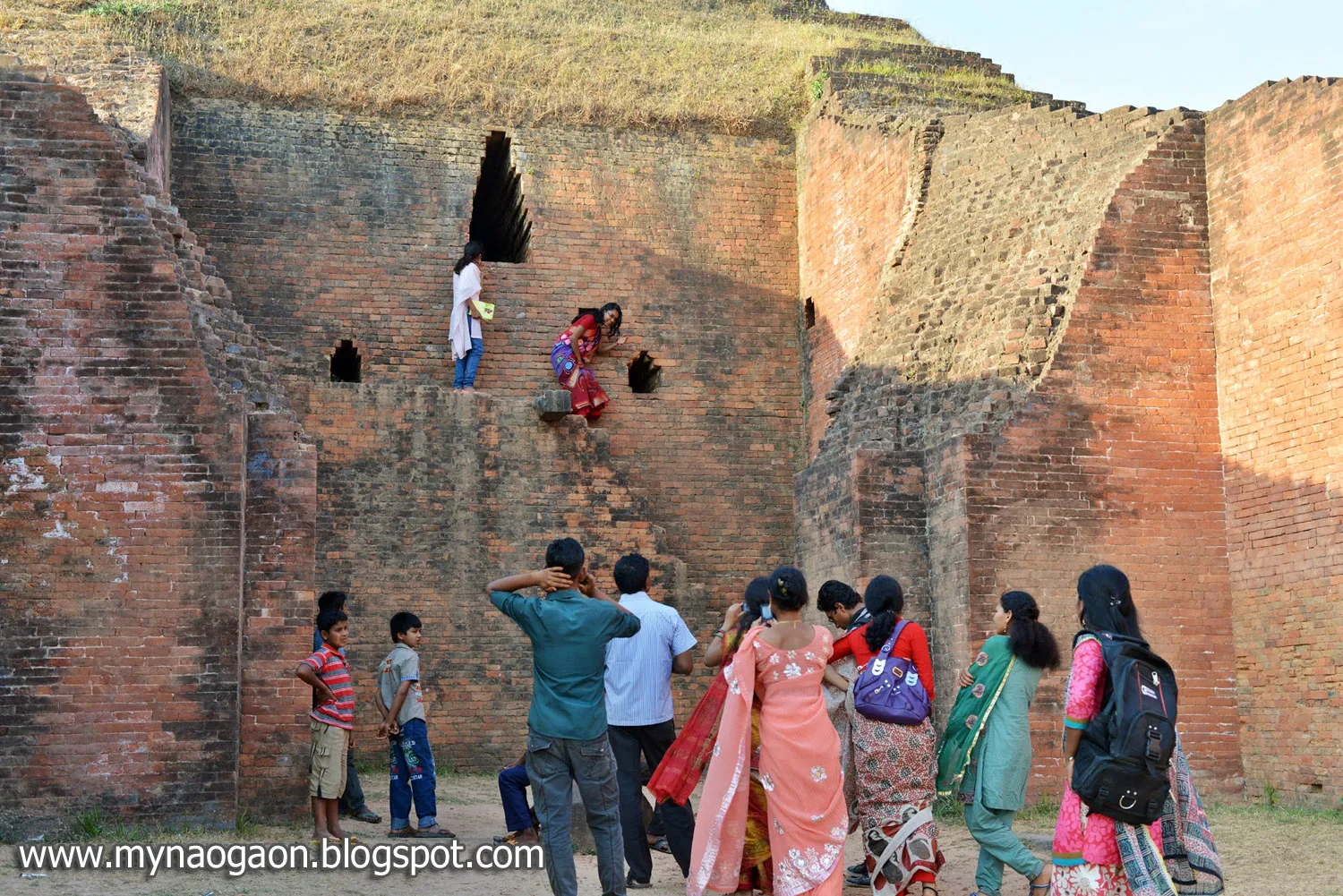
A Close view of Paharpur Vihara’s Central Temple. Photo: 2013. Some local visitors at Paharpur Vihara in 2013. Terracotta on Somapura Vihara’s central wall.
How to Visit Somapura Mahavihara?
From anywhere in Bangladesh, go to Naogaon town. Somapura Mahavihara is 34 km from Naogaon town and lies on the eastern side of the Naogaon-Joypurhat Regional Highway. Visitors can travel by train — the nearest station, Jamalganj, is only 5 km away. The site is also accessible from Joypurhat district headquarters (approx. 13 km).
Where to Stay and Eat in Somapura Mahavihara?
There is a government rest house inside the site available by prior booking. Naogaon town has many hotels; the most famous is ‘Mallika Inn’. Hotels are also available in nearby Badalgachhi and Joypurhat. At the entrance of the site, small food shops (locally called "hotel") sell Bengali foods, snacks and soft drinks. Recently, The Heritage Cafe opened within the site offering better-quality food.
The Heritage Restaurant inside the site – 2023.
Opening Hours and Entrance Fees of Paharpur Vihara
Tuesday to Saturday: 10:00 AM – 5:00 PM
Monday: 2:00 PM – 5:00 PM
Sunday: Closed
Break time: 1:00 to 1:30 PM on weekdays, 1:00 to 2:00 PM on Fridays.






_Bangladesh.svg.png)


%2Bcopy.jpg)

I LIKE 2 GO THERE . S.m.tamim
Thanks for the informative article..
ki kaje eta bebohar hoto i want know?????????
Excellent photography and good content. Really loved it.